How to Panelize PCBs within KiCad

Learn to panelize PCBs entirely in KiCad with key footprints and techniques for optimal fabrication and minimal warpage in assembly.
By
Kyle Hunter
June 25, 2025
 (Updated
August 2, 2025
)

Panelizing PCBs from withing KiCad

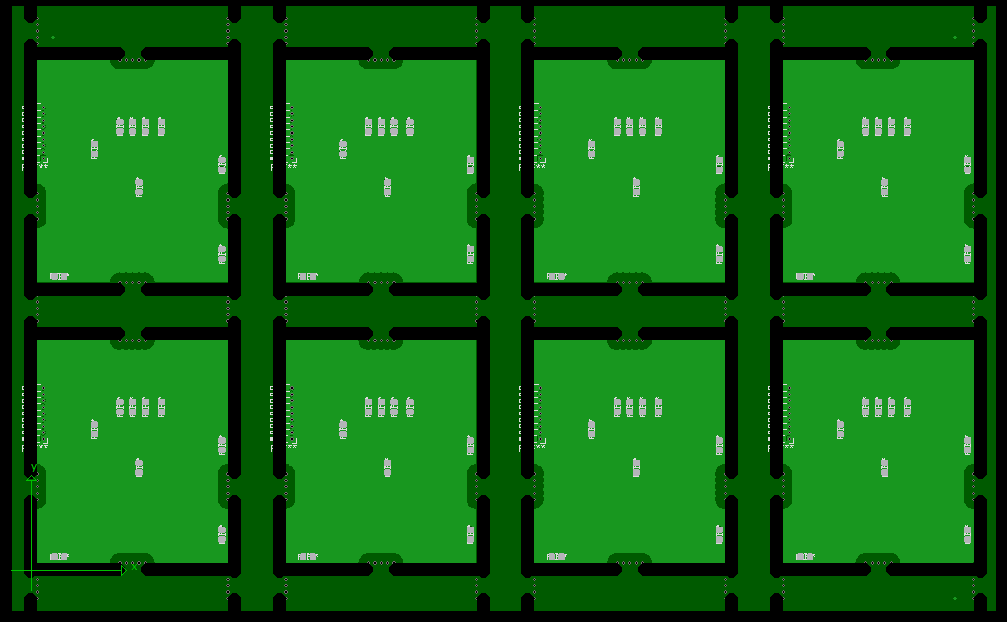
I’ve posted two YouTube videos (Video 1 & Video 2) going over how we panelize PCBs entirely with KiCad. In doing so, we use several footprints I created. The most important two are the SINGLED_SIDED_TAB and the DOUBLE_SIDED_TAB. These footprints use the Cmts.User layer to show the fab house where a 2mm router should be used. The panel below was DFM’d and rendered using the gerber tool Fab3000

Example of PCB panel created within KiCad
Render of a mouse bite tab created within KiCad using our library. Notice the large supports going North and South. This ensures that your assembly house will not have to battle panel warpage while assembling.

The biggest drawback of using KiCad like this is that there is no way to directly update the panel when the PCB version updates. Our method focuses on making the initial panel as simple/fast as possible. When needing to update the board, it is quick enough to just recreate the entire panel directly. One item to note that I don’t fully mention in the video is in regards to the Cmts.User. You must ensure that no other footprint on the board uses this layer. Some default KiCad mounting holes use it. This can make the fab house upset and potentially make a mistake on the creation of the board.

The Github link to our panelizing library can be found here.

Recent Blogs

Lithium Ion Battery Charger Circuit: Load Sharing
Created at:  
June 25, 2025
Updated at:  
September 11, 2025
Kyle Hunter
Open cardboard box with flaps folded outward, icon style.
Uncatogrized
Chat bubble icon representing comments or messaging.
Comments
White heart icon on transparent background.
0
Explore best practices in lithium-ion battery charger circuit design for safe load sharing. Discover methods to optimize power supply while charging.
Rise Time and Series Resistors: EMC For Everyone 2
Created at:  
June 25, 2025
Updated at:  
September 9, 2025
Kyle Hunter
Open cardboard box with flaps folded outward, icon style.
Uncatogrized
Chat bubble icon representing comments or messaging.
Comments
White heart icon on transparent background.
0
Explore the impact of signal rise time on electromagnetic emissions and learn how using a series resistor can reduce EMI in your electronic designs.
Patent Before Prototype: Which Comes First?
Created at:  
June 26, 2025
Updated at:  
September 11, 2025
Kyle Hunter
Open cardboard box with flaps folded outward, icon style.
Uncatogrized
Chat bubble icon representing comments or messaging.
Comments
White heart icon on transparent background.
0
Learn when to prototype or patent your invention first and protect your idea. Explore NDA usage, provisional patents, and Lean Startup methodology insights.
PCB Power Input Protection: Reverse Polarity, Overvoltage & Overcurrent Explained
Created at:  
January 4, 2026
Updated at:  
January 22, 2026
Kyle Hunter
Open cardboard box with flaps folded outward, icon style.
Uncatogrized
Chat bubble icon representing comments or messaging.
Comments
White heart icon on transparent background.
0
Learn how to design reverse polarity, overvoltage, and overcurrent protection for PCB power inputs to improve reliability and prevent damage.

MicroType Engineering strives to help businesses turn an idea into a physical product. Whether you are already established and seeking to branch out into a new product or working on an exciting new startup project, MTE can guide you along the way.

MTE provides rapid prototyping, enabling you to quickly have a physical product in your hands to showcase and test. MTE offers a personalized approach, helping navigate the often confusing, and expensive path to manufacturing and selling a product. Contact us to learn more.